


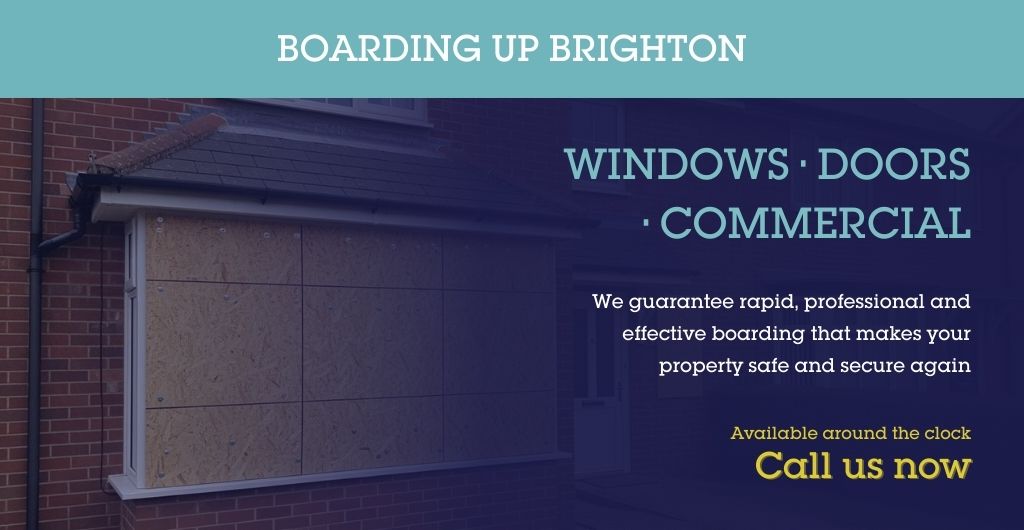
Commercial boarding up in Brighton (BN1–BN88)
Commercial property damage is stressful for any business owner or facilities manager—especially when it affects your ability to trade, protect stock, or meet insurer requirements. We provide commercial boarding up in Brighton and across the BN postcode area (BN1–BN88), securing shops, offices, pubs, restaurants, industrial units and public buildings after break-ins, vandalism, storms, fires, floods and accidents.
If you’re dealing with a smashed shopfront on Western Road, a forced door at a business park off the A27, or a damaged rooflight on a warehouse unit, the priorities are the same: make the building safe, prevent further loss, and document what’s been done.
For urgent help, see emergency boarding up. For an overview of all options, browse our boarding up services in Brighton.
The commercial situations we’re called out to (and why they’re different)
Commercial sites are rarely “simple window jobs”. Access, public safety, and the size of openings all change how boarding needs to be done—often at awkward hours, with customers and staff nearby.
Typical scenarios we handle include:
- Smashed shopfront glazing (rammed, vandalised, or accidental breakage) on busy streets and parades
- Forced entry to doors on offices, storage units, schools and back-of-house entrances (damaged locks, splintered frames)
- Repeated targeting of vacant retail units, kiosks and storerooms where standard plywood gets removed
- Storm damage to skylights, roof panels and loose glazing where wind-driven rain becomes the immediate risk
- Fire damage where glazing and doors are compromised after the fire service has finished (we secure the perimeter; we don’t provide smoke/odour remediation)
- Flood damage where frames swell, doors won’t shut properly, or ground-floor glazing becomes vulnerable
- Impact/accident damage (vehicle strike to frontage, loading bay incidents, street furniture collisions)
If the property is open to the public (or sits on a busy pavement), we’ll also consider safe edges, trip hazards, and preventing debris—as well as the security aspect.
For event-led guidance, you may also want:
- boarding up after burglary repairs
- boarding up after vandalism repair
- storm damage boarding and securing
- fire damage securing
- flood damage securing
- accident damage boarding up
Common commercial property types we secure around Brighton & the BN area
Brighton and Hove’s building stock is varied, and that affects how we fix boards and how we protect the fabric of the property:
- Ground-floor retail units with large glazed shopfronts (often aluminium frames and toughened glass)
- Restaurants, pubs and cafés with multiple access points (front doors, side returns, yard gates, cellar doors)
- Offices in period buildings—especially in central Brighton and Hove—where non-destructive fixing matters
- Industrial units and workshops around routes like the A23 and A27, where larger openings and roller shutters are common
- Public-sector and community buildings where access, safeguarding, and documentation are important
Commercial boarding up is often about balancing security (anti-tamper, resistance to removal) with practicalities (safe customer access, fire exits, and not causing unnecessary damage to frames).
Our methods: how we board up commercial buildings (what we use and why)
There isn’t one “standard” method that suits every shopfront or office. We choose a fixing approach based on the opening size, the surrounding material (timber, uPVC, aluminium, masonry), and whether the building will be unattended.
Materials we typically use
- 18mm exterior-grade plywood for strong, reliable boarding on larger or high-risk openings
- OSB (often 12mm) for smaller openings or lower-risk temporary protection where appropriate
- Anti-tamper fixings where there’s a risk boards could be removed from outside
- Temporary steel doors for doors that have been forced or are too damaged to secure safely
- Steel security screens for voids or repeated attacks where a longer-term, more robust option is needed
We’ll always explain what we recommend and why. If the surrounding frame is too damaged to use non-destructive methods, we’ll talk you through options before proceeding.
Window and glazed frontage boarding (commercial)
Retail glazing tends to fail “big” and in public view. Our approach is designed to quickly make the area safe, then secure it.
For standard glazing or side panels, we’ll usually carry out window boarding in Brighton. For full-width retail frontages, see shopfront boarding.
We pay close attention to:
- Load and span on wide openings (so boards don’t flex or work loose)
- Fixing locations to avoid damaging mullions, door closers, and shopfront systems where possible
- Edges and protrusions to reduce snag risks on pedestrian routes
Door security: boarding vs temporary steel doors
After forced entry, a boarded door can be a short-term measure—especially if the door leaf is compromised or the lock area has splintered.
Where appropriate, we provide door boarding in Brighton. If the door is not realistically securable (or the building needs regular access while repairs are arranged), we can fit a temporary steel door as a practical “working solution”.
Temporary steel doors are particularly useful for:
- back-of-house entrances on restaurants and pubs
- service corridors and staff-only doors
- vacant units where you need stronger security than timber boarding
Rooflights, skylights and overhead openings
Commercial premises often have vulnerable overhead glazing—rooflights on flat roofs, skylights above stairwells, or panels over loading bays. After storms or impact damage, water ingress becomes the immediate problem.
Our roof boarding service focuses on securing openings and limiting weather entry. Access can be the challenge: we’ll discuss safe access arrangements before attending if the roof is high or restricted. (We’re here to secure the opening; full roof repairs are for a roofer.)
Longer-term perimeter control (where needed)
Some commercial sites need more than boarding—particularly if there’s a partially open frontage, ongoing works, or a safety concern around public access. In those cases, temporary fencing can help create a safe boundary while glazing and doors are being replaced.
What to expect when you call us (commercial-focused)
When a business calls, they usually need a clear plan and documentation they can pass to insurers, landlords, or head office.
-
Initial questions (2 minutes that save time)
We’ll ask what’s damaged (shopfront/door/roof), whether anyone is on site, and if there are immediate hazards (loose glass, exposed electrics, unstable frames). -
Attendance and safety-first assessment
On arrival we’ll assess access, hazards, and the condition of frames and surrounding structure. If anything looks structurally unsafe, we’ll tell you—boarding can’t fix structural movement. -
Securing the building
We’ll board or screen the affected openings using the most suitable method for security and practicality. -
Documentation for your records
You’ll receive:- time-stamped photos of the secured areas
- a clear statement of works
- an itemised invoice suitable for insurers/landlords in most cases
We’re not loss adjusters or legal advisers, but we know what documentation insurers typically ask for. For more guidance, see insurance claims help.
Commercial-specific considerations (landlords, agents, and facilities teams)
Commercial jobs often involve more stakeholders than residential work. We regularly coordinate with:
- commercial landlords and managing agents
- facilities management teams
- building managers and caretakers
- contractors scheduled for glazing/door replacement
If you need access arrangements (keys, alarm codes, contact on site) we’ll discuss that upfront. If the property is vacant, you may also want to read about vacant property boarding up, as the recommended security level is often different.
A realistic example: securing a damaged shopfront in central Brighton
A common call-out is a retail unit where the toughened glass shopfront has shattered overnight, leaving the premises exposed. In central Brighton that can mean high footfall early in the morning, nearby businesses opening up, and a need to protect stock and the interior from both theft and weather.
In a scenario like this, we’ll typically:
- make the area safe (checking for loose shards and unstable frame sections)
- install strong boarding across the opening using suitable fixings for the shopfront system
- confirm whether you need access in and out (so we don’t block essential entry points)
- provide photo documentation for the insurer and for your glazier’s follow-on visit
If the unit is likely to be targeted again before glazing can be replaced, we’ll discuss whether a stronger option (such as screens) is appropriate.
Areas we cover for commercial boarding up (Brighton & BN postcodes)
We cover Brighton and Hove and the wider BN area, including coastal towns and inland villages where there are industrial estates, high street parades, schools, offices and farm-based commercial units.
Common commercial call-out locations include:
- boarding up in Brighton (BN1/BN2)
- boarding up in Hove and boarding up in Aldrington (BN3)
- boarding up in Portslade (BN41)
- boarding up in Shoreham-by-Sea (BN43)
- boarding up in Worthing (BN11/BN12/BN13/BN14)
To check your town or village, see areas we cover.
FAQs: commercial boarding up in Brighton
Can you secure a shopfront without permanently damaging the frame?
Often, yes. Where the frame is sound, we’ll use fixings and methods that aim to be as non-destructive as possible. If the frame is already twisted, cracked or pulling away, we’ll explain the limitations before we begin—sometimes “perfectly non-destructive” simply isn’t achievable on a badly damaged shopfront.
Is commercial boarding up covered by insurance?
Many commercial policies include cover for securing a building after a break-in or damage, but the wording varies. Keep your crime reference number (if applicable), take photos if it’s safe, and contact your insurer early. We can provide the documentation insurers typically request—see insurance claims help.
Can you board up a premises that needs to reopen quickly?
Yes—tell us if you need customer access, staff access, or to maintain a specific entrance. Depending on the damage, a temporary steel door or a tailored shopfront board arrangement can allow access while still securing the vulnerable area. Where appropriate, we’ll point you to door boarding or shopfront boarding.
Do you work with managing agents and facilities managers across multiple BN sites?
Yes. We regularly support commercial stakeholders who need consistent documentation and a reliable method statement for different properties across BN postcodes. If you’re coordinating multiple locations, it’s helpful to email site addresses and contact details to [email protected].
How much does commercial boarding up cost in Brighton?
Costs depend on the size and number of openings, access, materials required (plywood vs screens, temporary steel doors), and whether additional safety measures are needed. We don’t publish fixed prices because commercial sites vary so much—see boarding up pricing for the factors that affect cost.
Helpful links
- emergency boarding up
- shopfront boarding
- window boarding in Brighton
- door boarding in Brighton
- roof boarding service
- areas we cover
- insurance claims help
- boarding up pricing
- FAQs
- contact us
Ready to secure your commercial property?
Ready to get started? Call 01273 092 166 or email us for a free, no-obligation quote.
